Spec-Driven Development for AI-Assisted Teams
Your engineers are shipping more code than ever and the delivery metrics still have not moved. The gap is usually a missing control layer: written intent that an agent's output gets reviewed against, before anything is generated.

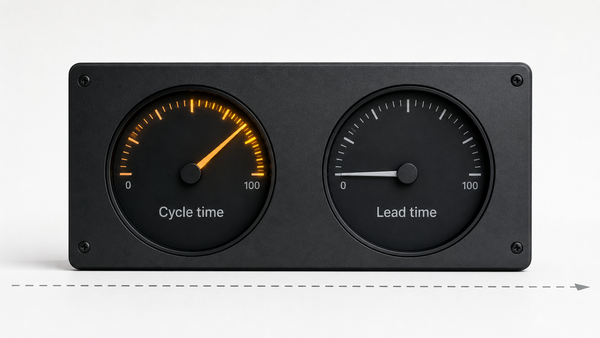
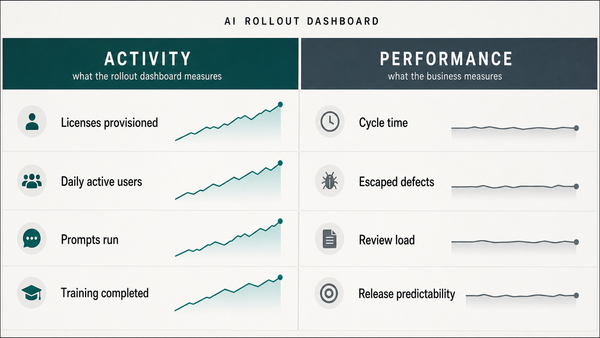
A few months into rolling out agentic coding, I started noticing the same pattern in every retro. Engineers were producing more code than ever. The work felt fast. The PRs looked sensible. And yet the delivery metrics had not moved. Cycle time was flat. Reopened-defect rates were creeping up. Architecture reviews were getting longer, not shorter.
The diagnosis took a while to land, and once it did, it was uncomfortable. The teams that felt the most accelerated were the ones whose agents had the least to push back against. A vague request produced a plausible answer, and the plausible answer became the codebase. Nobody was reviewing intent. Everybody was reviewing output.
The discipline that fixes this is now called Spec-Driven Development, and by 2026 it has become a recognizable category. Every major AI coding tool ships its own flavour. The reason is not fashion. The reason is structural: when an agent generates the code, the tests, and the architecture, the written specification stops being optional documentation and becomes the institutional control layer that makes the delivery org's output reviewable against intent rather than against itself.
This essay is the long form of that argument. It walks through why specs become mandatory once an agent is in the loop, the predictable failure modes when they are not, and how the discipline lands role by role inside a delivery org. It is not a tooling guide. It is a description of the operating-model shift that makes AI in delivery actually move the numbers.
Without a written intent, an AI agent is not a junior engineer: it is an anonymous contractor
The first thing most teams get wrong is the mental model. The agent gets treated like a junior developer. You give a junior developer a vague ticket, you expect a few clarifying questions, you accept that the first attempt will be off, and you correct it in review. That model is socially familiar. It comes with built-in checkpoints: the standup, the pairing session, the PR walkthrough.
An AI agent does not match that model. When an engineer types "add login" into an agent, the agent does not stop and ask which auth provider, which session strategy, which password policy, which password-reset flow, which audit-log shape. It picks defaults. The defaults are plausible. The defaults are sometimes correct. And then the defaults become the codebase, because no one was asked to ratify them.
The right mental model is closer to an anonymous contractor working from a one-line work order. The contractor will produce something. It will look professional. It may even be acceptable. But the work order does not include the constraints, so the contractor fills them in, and the org inherits whichever constraints the contractor chose. With a human contractor on a high-stakes job, no engineering manager would accept that arrangement. They would write a specification.
The same instinct has to apply to agents. Not because the agent is incompetent, but because the agent has no way to be insubordinate. It cannot push back. It cannot say "this is under-specified, get me a BA on the line." It picks defaults and moves on. A common pattern: an agent adds a complete user-registration flow with email verification, password complexity rules, and a confirmation page in a sans-serif typeface that doesn't match the codebase's conventions. Every piece is plausible. None of it was discussed. All of it lands in production-adjacent code by the next morning.
What looks like acceleration here is delegation without a contract. The delegating party is the engineer. The accepting party is the codebase. The contract that should have governed the work is missing. In its absence, the agent's training-data priors quietly become the org's defaults. Multiply that across forty engineers and ninety days, and the codebase has dozens of decisions nobody can trace back to a discussion. Cycle time looks healthy. Architectural review queues grow. Reopened-defect rates climb.
The implication for an operating model is that AI in delivery is not "junior staff with a productivity multiplier." It is delegation through a different surface, and that surface needs its own governance: written specifications, not standups. A delivery org that does not install that governance before scaling AI coding is not transforming. It is signing blank work orders at machine speed.
Specs are the control layer, not the documentation layer
For most teams, the word "spec" carries baggage. A spec is what the BA writes after the PM has approved the feature, and what gets archived in Confluence somewhere between the brand guidelines and the 2019 onboarding deck. Under classical development, that placement was tolerable. The spec described what was built; the code was the source of truth; the spec was reference material for whoever showed up six months later.
Under AI-assisted development, the placement inverts. The spec is no longer the after-the-fact documentation of what was built. It is the before-the-fact contract that an agent's output is reviewed against. Without that contract, every PR review collapses into a single question: "does this look plausible?" Plausibility is not a quality bar. It is a guess about whether the agent's defaults align with the team's intent, made by a reviewer who was not present at the moment those defaults were chosen.
This is the reframe most leaders miss. Specs are not a documentation deliverable that arrives after the work. Specs are a control layer that exists prior to the work, and the work has to satisfy them. The shift is from "the spec describes the code" to "the code satisfies the spec." The direction of fit reverses.
The mechanism is mechanical, not philosophical. When an agent generates an implementation against a written spec, three things become true that were not true before. First, the review surface is the spec, not the diff. A reviewer asks "does the diff satisfy the spec?" rather than "does the diff look right?". Second, the test surface is the spec, not the implementation. QA writes assertions against intent, not against what the agent produced. Third, the architectural surface is the spec, not the codebase. Solution architects review whether the spec is consistent with the architectural envelope before the agent ever runs.
None of those three are possible without the spec existing first. None of them are reliably present in a delivery org that treats specs as archival documentation. And all three are exactly the surfaces where AI-assisted delivery quietly degrades when they are missing: review queues overflow because reviewers fall back to reading code, reopened-defect rates climb because tests verify the agent rather than the intent, architecture debt accumulates because boundary violations slip in one prompt at a time.
For an executive accountable for delivery, the implication is concrete. The spec is the institutional artefact that decides whether the delivery org reviews intent or reviews output. Documenting what was built is a useful historical artefact and a poor governance one. Governing what gets built is what the spec has to do, and that means it has to exist before the agent does anything. A delivery org that promotes specs from documentation to control layer is changing its operating model. A delivery org that keeps specs as documentation under AI-assisted delivery is governing the codebase by inference.
The failure-mode taxonomy is structural, not vendor-specific
When the control layer is missing, the resulting failures are not random. They are a small, predictable set, and every delivery team I have observed go through this hits the same six.
Intent drift is the cheapest to describe. A vague prompt produces a plausible default the team never agreed to. "Add login" becomes a particular session shape, a particular hashing strategy, and a particular set of fields on the user model. None of those were specified. All of them are now codebase truth. The cost shows up two sprints later when the team realises the auth model contradicts a constraint nobody wrote down.

Context decay is the longer-running version. The agent has a finite effective context window. Past that window, prior decisions are forgotten. The same agent that wisely chose JWT in February silently chooses session cookies in May, in a different file, because the original decision was not in its working context. The codebase contradicts itself, slowly, and nobody traces the contradiction back to the absence of a written constraint.
Hallucinated APIs and contracts are the most visible. The agent produces plausible function calls to endpoints that do not exist, or invokes a library version with a different signature, or constructs a contract that the consumer cannot satisfy. Integration tests catch some of this. Production catches the rest. None of it would survive a review against a written interface spec, because the interface would have been pinned.
Duplicated logic is the quiet one. Agents paste rather than refactor. They cannot find what they cannot see, and what they cannot see is everything outside the current context window. Industry analyses from 2026 confirm the pattern: code cloning under AI-assisted development is meaningfully higher than under human-only development. The team ships, the team feels productive, the team accumulates four implementations of the same domain rule and discovers it the first time one of them needs updating.
Architectural drift is the structural one. The 2026 Sonar State of Code Developer Survey found that 42% of developers flag architectural inconsistencies or drift from intended design as a major concern with AI coding tools. The mechanism is direct: every prompt is local, every codebase is global, and the gap between those two scales is exactly where boundary violations live. A service-level constraint that lives in an ADR document the agent never reads will be silently violated, one prompt at a time, until the architecture review surfaces a problem the codebase has already absorbed.
Weak test coverage completes the set. When the agent writes both the code and the tests in the same prompt, the tests verify what the agent produced rather than what the team intended. Coverage looks healthy. The pyramid looks correct. The CI signal stays green. Intent stays unverified. Three sprints later, a refactor breaks a behaviour no test was actually pinning, because the tests were pinning the implementation.
The pattern across all six is the same shape: an agent without a written intent fills the gap with defaults, and the defaults compound. This is not a vendor problem. By 2026 every serious AI coding tool ships its own SDD discipline. GitHub Spec Kit, AWS Kiro, Claude Code, Cursor, and OpenSpec are five recognized examples in the 2026 SDD landscape. The failure modes are not specific to any one of them. They are specific to the absence of a control layer.
The discipline has a roster, a workflow, and a set of hooks: it is an operating model, not a writing exercise
Once a team accepts that specs are mandatory, the install question follows. The honest answer is that spec-driven requires a small operating model, not a templating habit. One such operating model is a spec-driven agentic pipeline where specialized agents collaborate through enforced workflows, phase gates, and automated hooks. The specific tooling matters less than the shape of the discipline, and the shape is consistent across every credible SDD implementation I have studied.
The discipline has three load-bearing components.
The first is a workflow with explicit phases. The phases progress from product intent (PRD) to feature decomposition to task-level specifications to implementation. Each phase produces an artefact that the next phase consumes. The PRD becomes the source of feature specs; feature specs become the source of task specs; task specs become the input to the implementation agent. The progression is not a waterfall because phases iterate, but it is a directed flow, and each phase has a defined input and output. The reason for the explicit shape is that an agent at the wrong phase is a contractor with the wrong work order. Asking an implementation agent to invent a feature is the same category of mistake as asking a junior developer to ratify the product strategy.
The second is phase gates between phases. A phase gate is the operating-model artefact that says: this phase's output has to be ratified before the next phase begins. Phase gates are where the operating model gets enforced. Without them, an organisation can have a written PRD and still let implementation agents run on a stale or contradictory feature spec, because no one explicitly approved the transition. With phase gates, the org has a small number of designated moments where humans say "yes, this is the intent we are handing to the next phase." Those moments are where governance lives. Standups and retros are downstream of them.
The third is hooks that mechanically enforce constraints. Hooks are the difference between social enforcement and mechanical enforcement. A social hook is "we agreed in standup that all new endpoints get OpenAPI specs." A mechanical hook is a CI step that fails the merge if an endpoint lacks an OpenAPI spec. AI-assisted delivery makes mechanical enforcement non-negotiable for the same reason it makes specs mandatory: the volume of generated output is too high for social enforcement to keep up. The control layer has to be reified in CI, in pre-commit checks, in PR templates, in lint rules. Whatever the discipline can encode, the discipline should encode.
When those three components are present, the team has an operating model. Roles know which phase they own. Decisions have an explicit ratification point. The contract between intent and implementation is mechanically enforced. The agent's output gets reviewed against the spec, the spec gets reviewed against the architecture, the architecture gets reviewed against the product intent. The chain is auditable.
A team that installs only the templating habit, writing specs without phase gates and without hooks, has not installed the discipline. It has written documents. The control layer requires the workflow, the gates, and the hooks together. Anything less is a habit, and habits decay under volume.
Spec discipline lands role-by-role, not org-wide
The most common implementation failure pattern I see is treating SDD as an org-wide initiative. "We are now spec-driven" is announced, templates are circulated, and nothing in particular changes on Tuesday. The reason is that spec discipline does not land at the org level. It lands at the role level, because every role's review surface is different. The role-by-role redesign matters more than the announcement.
The same logic I apply to evaluate AI maturity for individual roles applies here. I document those L1–L4 evaluations across role-specific frameworks for Software Engineers, QA Engineers, Solution Architects, Business Analysts, Project Managers, and DevOps. The frameworks differ because the work differs. Spec-driven discipline differs by role for the same reason.
Software engineers stop reviewing diffs and start reviewing diffs against specs. The skill that becomes load-bearing is reading a spec critically, asking whether the spec is unambiguous, complete, and consistent, before any code is generated. A senior engineer at L3 spends meaningful time on spec critique, not on line-by-line implementation review. The agent does the implementation; the engineer's marginal contribution is upstream of the agent.
QA engineers stop deriving tests from the implementation and start deriving them from the spec. This is the single largest shift in the role. Under classical development, a QA could ask the developer "what did you build?" and write tests against that. Under SDD, that path produces tests that verify the agent's defaults rather than the team's intent. QA derives test cases from the spec, before or in parallel with implementation. The test suite becomes a second representation of intent, independent of what the agent produces.
Solution architects stop reviewing finished services and start reviewing specs. The architectural envelope that constrains the system has to be readable as part of the spec. SAs own that envelope. When a feature spec arrives, the SA's job is to confirm it is consistent with the boundaries: that it does not introduce a coupling the architecture forbids, that it does not duplicate a capability that lives elsewhere, that it respects the agreed contracts between services. Reviewing finished services for those properties is downstream and expensive. Reviewing specs is upstream and cheap.
Business analysts become the spec authors. This is the role whose work changes most in shape and least in spirit. A BA's job has always been to translate intent into a form an implementer can execute. Under SDD, the implementer is an agent, and the translation has to be tighter. The acceptable level of ambiguity in a requirement document drops sharply. A BA at L3 produces specifications an agent can implement without picking defaults, and stays available for clarifications mid-implementation.
Project managers own the phase gates. The gates are not bureaucratic checkpoints; they are the moments where intent gets ratified before it propagates. The PM's role is to ensure those moments happen, that the right reviewers are present, and that the team does not start phase N+1 before phase N has produced a ratified artefact. PMs who treat the gates as ceremony will see the discipline degrade; PMs who treat the gates as the enforcement layer of the operating model will see it hold.
DevOps engineers install the hooks. Every constraint the team agrees to has to be mechanically enforceable somewhere: in CI, in pre-commit, in PR templates, in lint configuration, in deployment guards. DevOps owns that enforcement surface. The role that used to be "keep the pipeline running" becomes "make the spec contract physically inescapable."

The implication for an executive is that announcing SDD is not the same as installing it. The announcement is a slide. The installation is six role-level redesigns. Skip the redesign and the discipline stays decorative. Do the redesign and the operating model actually changes shape.
Spec discipline is the prerequisite, not the side-quest
The trap most companies fall into is treating the spec layer as a writing exercise to assign after the AI tools roll out. The sequence in their head is: buy Copilot, run pilots, find some wins, formalize the writing later. The sequence that actually works is the inverse. The spec layer is the prerequisite that decides whether the wins compound or evaporate.
A delivery org that rolls out agents without a control layer in place is signing blank work orders at machine speed. The first three months will look healthy. PR throughput will climb. Some teams will report dramatic acceleration. Reopened defects, architectural drift, and review-queue length will all be quietly accumulating in the background, invisible until a quarter or two later when cycle time goes flat and the executive sponsor cannot explain why.
A delivery org that installs the spec layer first, with phase gates, role-level redesign, and hook-based enforcement, sees less spectacular early numbers and a meaningfully better trajectory. The agents are slower at the start because the spec contract is harder to satisfy than the plausibility bar. Six months in, the same teams are producing implementations that survive review the first time, tests that catch real intent violations, and architectures that do not need a quarterly cleanup. The slope flattens out, not the level.
The shape of the choice is familiar to anyone who has done org-design work. Installing governance before scaling is uncomfortable in the short run and load-bearing in the long run. Skipping the governance and "moving fast" is comfortable in the short run and expensive in the long run. AI-assisted delivery just compresses the timeline. The cost that used to surface in eighteen months under human-only development surfaces in three under agentic development, because the volume of output is higher and the gap between intent and implementation is wider.
The full discipline can be operationalized in more than one way, and there will be others. What is not optional is the shape: written intent prior to generation, phase gates between work products, mechanical enforcement of the constraints the team agrees to, role-level redesign of every review surface. A delivery org with that shape can use any of the 2026 agentic tools and produce measurable capability. A delivery org without it is treating spec discipline as a side-quest, and watching its AI investment fund a faster path to the same flat metrics.
AI Transparency Notice: This article and its accompanying images were created with the assistance of generative AI. The author directed the content, contributed the underlying ideas and analysis, and reviewed the final publication.